Sunriver Car Accident Attorney: What to Do After a Crash on Sunriver’s Private Roads
If you’re looking for a Sunriver car accident attorney, you may have already noticed something strange about the crash you were in. Sunriver looks like a small town. It has streets, intersections, speed limit signs, a police department, and a fire station. Legally, though, it isn’t a town at all, and the road you were hit on probably isn’t public.
Ryan Hilts Law represents people injured in Oregon collisions, and its car accident practice area explains how these claims generally work.
The Sunriver Owners Association owns and maintains the streets inside the community, along with the 34 miles of paved pathways that run through it. That private status doesn’t take away your claim. It can change which agency investigates, which records exist afterward, and which rules the other driver was actually subject to.
Sunriver also fills and empties with the seasons. Roughly 1,500 people live here year-round, and on a peak summer weekend the population can approach 20,000. Many of those drivers have never seen these roads before; many are in rental cars, and plenty carry insurance written in another state.
This guide explains how a Sunriver crash claim generally works, where these collisions tend to happen, and how Oregon’s own benefits may apply.
Also Read
- Auto Accidents on Highway 97
- Car Accident Attorneys in Bend, Oregon
- Central Oregon Personal Injury Attorney
TL;DR
Sunriver’s roads and pathways are private property owned by the Sunriver Owners Association, not county roads. Oregon law closes most of the gap that would otherwise create. Under ORS 801.305, the Oregon Vehicle Code treats roads open to the public that a homeowners association owns as highways for traffic enforcement, so long as they sit inside a service district established on or before July 1, 2002. The Sunriver Service District was established on exactly that date, so the speed and right-of-way rules that usually decide fault do apply on these streets.
Your own duties don’t change either. Under ORS 811.720, you must report a crash on a highway or on premises open to the public to the DMV within 72 hours if anyone is injured or damage exceeds $2,500. Oregon personal injury protection benefits may pay early medical bills regardless of fault, and uninsured or underinsured motorist coverage may matter when the other driver’s limits fall short. Oregon generally allows two years to file a personal injury lawsuit, and a crash involving a public agency vehicle can carry a 180-day notice deadline.
Key Takeaways
- Sunriver’s streets and pathways belong to the Sunriver Owners Association, so a collision inside the community happens on private property rather than a county road.
- For traffic enforcement, ORS 801.305 treats homeowners association roads inside a qualifying service district as highways, which keeps the Oregon Vehicle Code in play.
- The Sunriver Police Department works under the Sunriver Service District, a county service district the Deschutes County Board of Commissioners oversees.
- The DMV reporting duty under ORS 811.720 applies to premises open to the public, so a crash on a Sunriver street still must be reported within 72 hours once it meets the thresholds.
- Severe crashes in this area mostly happen on US 97. ODOT counted 10 crashes at the US 97 and Vandevert Road intersection over five years, nine of them with injuries.
- Oregon’s liability minimums are $25,000 per person, $50,000 per crash, and $20,000 in property damage, which a serious injury can exhaust quickly.
- A visiting driver’s out-of-state policy may carry lower limits than an Oregon policy and no Oregon personal injury protection benefits at all.
- When a rental car is involved, the rental company’s self-insurance under ORS 806.130 is generally secondary to the renter’s own policy.
- Oregon PIP may pay up to $15,000 in medical expenses incurred within two years of the crash, no matter who was at fault.
- Settling with an at-fault driver’s insurer without your own underinsured motorist insurer’s written consent can forfeit those benefits.
Why a Sunriver Crash Isn’t Quite Like a Crash in Bend
In Bend, the roads belong to the city or to ODOT, Bend Police or Oregon State Police investigate, and the paper trail is predictable. Sunriver works differently, and the differences show up early in a claim.
Sunriver is an unincorporated community on about 3,300 acres in Deschutes County, roughly 15 miles south of Bend and two miles west of US 97. It has no city council and no municipal public works department. The Sunriver Owners Association owns the streets and pathway network, sets the 25 mph limit that applies throughout the community, and maintains it all.
Three practical questions follow from that. Which agency responded and wrote a report? Which traffic laws applied to the other driver? And if a hazard on the road or pathway contributed, who was responsible for maintaining it? None of the three has the answer you’d expect from a city street.
Private Roads, Public Rules
The Traffic Laws Still Apply
Most of Oregon’s Vehicle Code attaches to highways, which ORS 801.305 defines as public ways open to the general public as a matter of right. Sunriver’s streets aren’t that. Under ORS 801.400, they fall into a second category: premises open to the public, which covers property the public can drive on, whether owned by a government or a private party.
For a stretch of time, that distinction left real gaps. The Sunriver Owners Association formally recognized the roads as premises open to the public in 2007, leaving local police unable to cite drivers for a set of minor traffic offenses. The Legislature responded. ORS 801.305 now provides that, for enforcing traffic offenses under the Vehicle Code, highway also includes premises open to the public owned by a homeowners association, as long as those premises sit within a service district established on or before July 1, 2002 under ORS 451.410 to 451.610.
The Sunriver Service District was established on July 1, 2002, through a management agreement with the Deschutes County Board of Commissioners and the Sunriver Owners Association. Sunriver qualifies. The speed, right-of-way, and careless driving rules that usually decide fault in a collision claim reach these streets.
The DMV Report Still Applies
ORS 811.720 requires a report when a crash happens on a highway or on premises open to the public, so the private status of a Sunriver street doesn’t excuse it. You must submit an Oregon Traffic Collision and Insurance Report to the DMV within 72 hours when anyone was injured or killed, when damage to your vehicle exceeded $2,500, when damage to any vehicle exceeded $2,500 and a vehicle was towed from the scene, or when damage to other property exceeded $2,500.
A police report doesn’t satisfy this requirement. The DMV report is separate, and Oregon law directs the DMV to issue a suspension notice when a required report never arrives. Visitors who drive home a day or two after a crash often miss this one.
Who Responds, and Why It Matters Later
The Sunriver Police Department operates under the Sunriver Service District, which the Deschutes County Board of Commissioners oversees under ORS chapter 451. Through the summer, it also runs a seasonal bike team that patrols the pathway network.
That structure matters in one specific situation. The service district is a public body, so a claim arising from a collision with a district police or fire vehicle may fall under the Oregon Tort Claims Act, which generally requires written notice within 180 days under ORS 30.275. A crash just outside the community may instead involve the Deschutes County Sheriff’s Office, Oregon State Police, or ODOT, each keeping its own records.
Where Sunriver Crashes Happen
US 97 and the Vandevert Road Intersection
The severe collisions around Sunriver generally happen on US 97 rather than inside the community. The highway carries heavy traffic at highway speeds past the Sunriver interchange, and high desert winter conditions can change the surface fast.
ODOT has been rebuilding the stretch between South Century Drive and the Forest Service boundary, and its project materials reported 10 crashes at the US 97 and Vandevert Road intersection over the preceding five years, nine of which resulted in injuries. The redesign lets drivers turning north cross through the median instead of crossing southbound traffic and merging at the same time.
The Entrances and the Connecting Roads
Most people reach Sunriver via Cottonwood Road or South Century Drive, and both drop from highway speeds into a 25 mph community in a short distance. Spring River Road, Huntington Road, and Vandevert Road carry local traffic that mixes residents who know every turn with visitors following a phone.
Inside Sunriver, at 25 MPH
Collisions inside the community tend to happen at lower speeds, and lower speed doesn’t mean minor. The pathway network crosses the roads repeatedly, children on bikes are everywhere in July, and deer move through year-round. Pathways have a 15 mph limit, and the roads are 25, and a driver who treats a Sunriver street like a rural highway can hurt someone badly at either speed.
Ryan Hilts Law handles bicycle accident claims and pedestrian crash claims throughout Oregon.
The Visitor Problem
When the Other Driver Lives Somewhere Else
Oregon requires every driver to carry liability coverage of at least $25,000 per person, $50,000 per crash, and $20,000 in property damage, plus personal injury protection and uninsured motorist coverage.
A visiting driver’s policy was written to another state’s rules. It may carry lower limits, and it very likely carries no Oregon personal injury protection benefits, because Oregon requires PIP on policies issued for delivery in this state. The practical effect is that the coverage available to pay for your injuries may be thinner after a crash with a visitor than after the same crash with a neighbor. That’s when your own uninsured and underinsured motorist coverage starts to carry the claim.
When a Rental Car Is Involved
Rental vehicles are common here, and the order of coverage surprises people. Large rental companies in Oregon generally operate as self-insurers under ORS 806.130. That statute makes the self-insurer’s liability protection secondary to any liability or uninsured motorist coverage available to the customer, and it requires the self-insurer to supply the statutory minimums only when the customer’s own policy doesn’t.
So after a crash involving a rental car, the renter’s personal policy is usually the first place to look rather than the rental company’s. Identifying the right insurer early can keep a claim from stalling, and the rental agreement, the renter’s declarations page, and any credit card coverage may each matter.
How Oregon Benefits Fit Into a Sunriver Claim
Personal Injury Protection
Oregon auto policies include personal injury protection, which pays regardless of who caused the crash. Under ORS 742.524, PIP generally covers up to $15,000 per person in reasonable and necessary medical expenses incurred within two years of the injury. It may also provide wage loss benefits of 70 percent of lost income for someone disabled for at least 14 days, subject to a cap of $3,000 per month and 52 weeks.
PIP is often the first money available after a crash, and that matters when the nearest hospital is in Bend, and treatment can’t wait for a liability decision. You can read more in the firm’s guide to personal injury protection in Oregon.
Uninsured and Underinsured Motorist Coverage
Oregon requires uninsured motorist coverage, and those limits generally match your own bodily injury liability limits, with a floor at the state minimum of $25,000 per person and $50,000 per accident, under ORS 742.502. Underinsured motorist coverage applies when the at-fault driver carries insurance but not enough, and the benefit is generally your own limit reduced by what you recover from that driver.
One rule here deserves more attention than it usually gets. As the Oregon State Bar explains, ORS 742.504 withholds underinsured motorist coverage when an insured settles with the liable party without the insurer’s written consent. An early offer from a visiting driver’s out-of-state insurer can look reasonable and still cost more than it pays. The firm covers Oregon’s underinsured motorist rules and uninsured motorist law in more detail.
When Fault Is Shared
Under ORS 31.600, a claimant’s own share of fault reduces the recovery in proportion to that share. You lose the right to recover only when your share exceeds the combined fault of everyone else whose fault is being compared. Carrying some of the blame may change what a claim is worth rather than ending it.
Oregon’s Deadlines
Under ORS 12.110(1), you generally must file an action for injury to the person within two years. A much shorter deadline may apply when a public body is involved. Under ORS 30.275, a claim against a public body generally requires written notice within 180 days of the injury, and within one year in a wrongful death case. Given how many agencies operate in and around Sunriver, that notice requirement may come long before the two-year filing deadline. The firm’s overview of the statute of limitations for car accidents walks through how the clock runs.
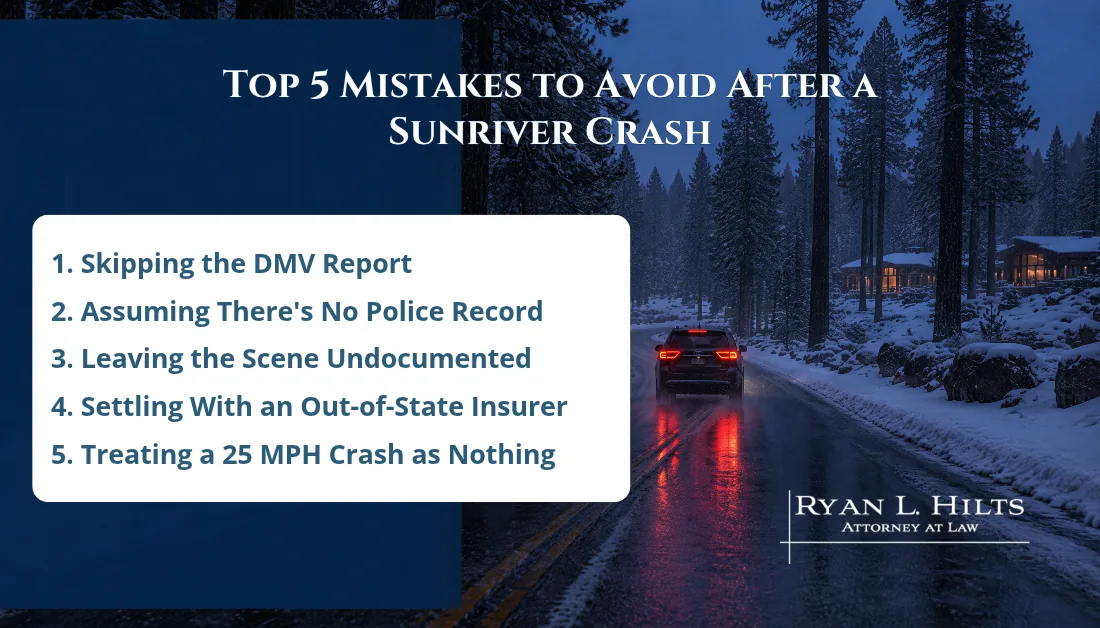
Top 5 Mistakes to Avoid After a Sunriver Crash
Save or share this if you were hurt in a collision in or around Sunriver.
1. Skipping the DMV Report Because You’re Heading Home
The 72-hour clock under ORS 811.720 doesn’t pause for the drive back. Filing late or not at all can cost you your Oregon driving privileges, and the report also creates an early record of the crash that insurers may rely on later.
2. Assuming There’s No Record Because the Road Is Private
Sunriver police do investigate collisions on these streets and do write reports on them. Requesting that report, rather than assuming it doesn’t exist, is often the difference between a documented claim and an argument about what happened.
3. Leaving the Scene Undocumented in a Place You May Never See Again
Local witnesses may be residents you can find later. Visiting witnesses go home that weekend. Photographs of the intersection, the sight lines, the snow or gravel on the pavement, and the other vehicle’s plate are far easier to take now than to reconstruct from several states away.
4. Settling With the Visiting Driver’s Insurer First
An out-of-state adjuster may offer policy limits that look generous next to a first medical bill. Accepting without your own underinsured motorist insurer’s written consent may forfeit the coverage you would need once the full cost of the injury is clear.
5. Treating a 25 MPH Collision as Nothing
Low-speed crashes produce real injuries, particularly to people on bikes and on foot. Symptoms that surface a week later are harder to tie to the crash when nobody was evaluated at the time.
When a Sunriver Car Accident Attorney May Become Necessary
Not every collision calls for legal help. You may be able to settle a minor crash yourself when fault is clear, the injuries are limited, and the adjuster cooperates.
The calculation may change in other situations. Consider seeking legal guidance when:
- You were injured seriously enough to need ongoing treatment
- The crash happened inside Sunriver, and you’re unsure which agency holds the report
- The other driver lives out of state, and their insurer is slow to engage
- A rental car was involved, and the insurers are pointing at each other
- The available limits appear too low to cover your medical bills
- You were struck while walking or riding at a pathway crossing
- A public agency vehicle was involved, and a notice deadline may be running
- You’ve been asked to sign a release or accept an early settlement
A Sunriver car accident attorney can request the responding agency’s report, identify every policy that may respond, coordinate PIP and underinsured motorist benefits so one doesn’t undercut the other, and track the deadlines that apply to your circumstances. Ryan Hilts Law represents injured people throughout Oregon, and its personal injury practice area explains how these claims are handled. For nearby communities, the firm also covers car accident claims in Bend and personal injury claims in Redmond.