Portland Uber Accident Lawyer: Who Pays After an Injury in an Uber Crash?
If you’re looking for a Portland Uber accident lawyer, you may already have run into what makes rideshare crashes different. In an ordinary collision, you usually deal with one careless driver and one insurance company. After an Uber crash, several policies may apply at once, and the one that does can depend on something you never saw: what the driver’s app was doing at the moment of impact.
Ryan Hilts Law represents people hurt in Oregon collisions, and its car accident practice area explains how these claims generally work.
The confusion is understandable. Many injured people have heard so much about Uber’s million-dollar coverage that they assume it covers every crash involving an Uber. It doesn’t. Coverage is tiered, and those tiers can change several times in a single shift.
This guide explains who may be responsible for paying after an Uber crash in Portland, how the app’s operating periods change the answer, and how your own Oregon benefits may fill the gaps.
Also Read
- 5 Signs It’s Time to Call a Rideshare Injury Lawyer
- What Happens If the Other Driver Is Uninsured in Oregon
- Portland Hit and Run Lawyer: What to Do After the Driver Flees
TL;DR
After an Uber crash in Portland, who pays usually depends on what the driver was doing on the app. If the app was off, the driver’s personal auto policy generally applies, and Uber’s coverage doesn’t. If the driver was logged in and waiting for a ride request, a smaller policy applies. From the moment a ride request is accepted until the passenger steps out, coverage of at least $1 million generally applies.
Portland’s city code sets those tiers, not an Oregon statute. Oregon requires rideshare companies to carry personal injury protection statewide, but it has never set liability limits, so the rules that govern your crash may depend partly on where it happened. Separately, your own personal injury protection benefits may pay early medical bills no matter who was at fault, and uninsured or underinsured motorist coverage may matter when the losses run past the available limits. Oregon generally allows two years to file a personal injury lawsuit, and a crash involving a public vehicle can carry a much shorter notice deadline.
Key Takeaways
- Uber’s liability coverage is tiered by app status, so the same driver may carry very different coverage at 9:00 and 9:05.
- While a driver is logged in and waiting for a request, Portland requires rideshare coverage of at least $50,000 per person, $100,000 per incident, and $25,000 in property damage.
- From acceptance of a ride request through drop-off, Portland requires at least $1 million combined single limit, plus $1 million in uninsured and underinsured motorist coverage.
- Portland City Code sets those liability limits. Oregon’s own rideshare statute requires personal injury protection benefits but doesn’t fix liability limits.
- Saving the trip details in the app early can matter, since app status is one of the first things an insurer may dispute.
- Oregon PIP benefits may pay up to $15,000 in medical expenses incurred within two years of the crash, regardless of fault.
- Settling with an at-fault driver’s liability insurer without your own underinsured motorist insurer’s written consent can forfeit those benefits.
- Being partly at fault may reduce what you recover rather than ending the claim, depending on how fault is divided.
Why “Who Pays” Is the Hard Question After an Uber Crash
In most collision claims, identifying the careless driver effectively identifies the insurer. Rideshare claims separate those two questions.
After an Uber crash in Portland, potential sources of payment may include the Uber driver’s personal auto insurer, Uber’s commercial policy, the other driver’s insurer, and your own policy through PIP or uninsured and underinsured motorist coverage. More than one may apply, and the order in which they apply can matter.
Rideshare companies classify their drivers as independent contractors, and Oregon has no statute or appellate decision settling whether that classification holds. That’s why an injured person’s path usually runs through the company’s insurance policy rather than a vicarious liability theory. It also explains why the app’s operating period matters so much. That switch determines which policy applies.
Uber’s Coverage Changes With the App
Both Uber and the City of Portland define coverage by what the driver was doing at the time of the crash. The periods below follow how Uber explains its own auto insurance coverage for drivers.
When the App Is Off
If the driver wasn’t logged in, the trip had nothing to do with Uber, and Uber’s commercial coverage generally doesn’t apply. The driver’s personal auto policy applies, subject to its own limits. For an injured person, this is effectively an ordinary car accident claim.
When the Driver Is Logged In and Waiting for a Request
This period covers a driver who has the app open and is available but hasn’t yet been matched with a rider. Coverage here is far lower than the figure most people have heard. In Portland, the required minimums are $50,000 per person for death or injury, $100,000 per incident, and $25,000 for property damage.
Those limits can fall short quickly. A single emergency department visit, imaging, and a short course of treatment can approach the per-person figure before you count any wage loss or longer-term care.
From Ride Acceptance Through Drop-Off
Once the driver accepts a ride request, coverage increases sharply and stays in place while the driver travels to the pickup, during the trip, and until the passenger exits the vehicle. In Portland, the requirement is at least $1 million combined single limit per incident for death, personal injury, and property damage.
Uber also describes contingent comprehensive and collision coverage for damage to the driver’s own vehicle during these periods, available only if the driver carries comprehensive and collision on a personal policy, and subject to a deductible that Uber lists as $2,500.
Why App Status Is Worth Documenting Right Away
Because the coverage difference between periods is so large, app status is one of the first facts an insurer may question. The boundary between waiting and accepted can be a matter of seconds, and the company, not you, controls the records that establish it.
If you can do so safely, take a screenshot of the trip in the app, including the trip receipt or trip history, the driver’s name, and the time. A passenger generally has this information in their own account. Someone hit by an Uber from another vehicle usually doesn’t have this, which is why the police report and the driver’s statement at the scene can matter later.
Portland Sets Its Own Rideshare Insurance Rules
The $1 million figure isn’t Oregon law, and that surprises many people who’ve read about rideshare claims elsewhere. Oregon does regulate rideshare insurance up to a point. Under ORS 742.520, a transportation network company must provide personal injury protection benefits covering its driver, the passengers, and any pedestrian the vehicle strikes while the driver is providing transportation services.
Oregon has never set a rideshare liability limit. The Legislature has taken it up more than once. House Bill 2995 in 2015 and House Bill 3195 in 2019 would each have set statewide insurance requirements for rideshare drivers, and both died in committee.
In Portland, the city sets the limits. Portland City Code 16.40.230 sets the insurance requirements for transportation network companies operating in the city, including the tiered limits described above and the $1 million in uninsured and underinsured motorist coverage that applies from acceptance through drop-off. The code also requires the company to provide proof of qualifying coverage if a driver’s insurance has lapsed or falls short.
Because liability requirements vary by location, the rules that apply to your crash may depend on the jurisdiction where it happened. A ride that began downtown and ended well outside the city may raise questions that a purely in-city crash doesn’t.
Where the crash happened matters in a second way. Portland’s High Crash Network is the set of streets and intersections where the most serious crashes occur. The city reports that these locations make up roughly 8 percent of Portland’s streets but accounted for an average of 67 percent of traffic deaths from 2020 through 2024. The network includes corridors rideshare vehicles use constantly, including Burnside, Sandy Boulevard, Powell Boulevard, Division Street, 82nd Avenue, Martin Luther King Jr. Boulevard, and Barbur Boulevard.
Who May Be Able to Recover After a Portland Uber Crash
Coverage analysis depends on where you were when the crash happened.
If You Were a Passenger in the Uber
A passenger is rarely at fault, and anyone riding in the vehicle is by definition in the period when the higher coverage applies. If the Uber driver caused the crash, the $1 million policy is generally the one in play. If another driver caused it and had little or no insurance, Portland’s uninsured and underinsured motorist requirement may offer an additional avenue.
If You Were in Another Vehicle
Here the app status question is decisive, and you may have no way to answer it on your own. If the Uber driver was on an active trip and caused the crash, the higher limits may apply. If the driver was merely logged in and waiting, the available coverage may be much smaller, and your own underinsured motorist coverage may become important.
If You Were a Pedestrian or Cyclist
People struck while walking or riding can pursue the same coverage as any other injured third party, and the same app-status analysis applies. Oregon law adds something here that many people miss. The PIP benefits a rideshare company must carry are written to cover pedestrians the vehicle strikes, not only the driver and passengers. Your own auto policy may also provide PIP benefits, even if you weren’t in a car. Ryan Hilts Law handles bicycle accident claims and pedestrian crash claims throughout Oregon.
If You Were the Uber Driver
Drivers face a particular risk. Oregon law expressly allows a personal auto insurer to exclude coverage, including PIP benefits, for a loss that happens while the driver is carrying passengers for compensation. A rideshare endorsement may close part of that gap. Damage to the driver’s own vehicle during an active trip may fall under Uber’s contingent coverage, but only if the driver carries comprehensive and collision personally, and the deductible may be substantial.
How Oregon Benefits Fit Into an Uber Claim
Whatever the rideshare coverage turns out to be, Oregon law may provide benefits that apply alongside it.
Personal Injury Protection
Oregon auto policies include personal injury protection, which pays regardless of who caused the crash. Under ORS 742.524, PIP generally covers up to $15,000 per person in reasonable and necessary medical expenses incurred within two years of the injury. It may also provide wage loss benefits of 70 percent of lost income for someone disabled for at least 14 days, subject to a cap of $3,000 per month and 52 weeks.
PIP is often the first money available after a crash, and it can keep treatment moving while the larger liability question is still unresolved. You can learn more about how these benefits work in the firm’s guide to personal injury protection in Oregon.
Uninsured and Underinsured Motorist Coverage
Oregon requires uninsured motorist coverage on auto policies, with minimum limits of $25,000 per person and $50,000 per accident. Underinsured motorist coverage applies when the at-fault driver has insurance but not enough, and the benefit is generally your own limit reduced by what you recover from the at-fault driver.
One rule here matters more than the rest. As the Oregon State Bar explains, ORS 742.504 withholds underinsured motorist coverage when an insured settles with the liable party without the insurer’s written consent. Settling first can cost those benefits entirely. Rideshare claims often involve several insurers and multiple settlement offers, so it’s easy to break this rule without meaning to. The firm also covers underinsured motorist coverage and Oregon uninsured motorist law in more detail.
When Fault Is Shared
Courts rarely treat fault in a multi-vehicle crash as all-or-nothing. Under ORS 31.600, a claimant’s own share of fault reduces the recovery in proportion to that share. You lose the right to recover only when your share of fault exceeds the combined fault of everyone else whose fault is being compared. Carrying some of the blame doesn’t necessarily end a claim, though it may change what the claim is worth.
Oregon’s Filing Deadline
Under ORS 12.110(1), you generally must file an action for injury to the person within two years. Two years can feel like a long time while you’re still treating, and it can disappear fast once insurance questions take months to resolve.
A much shorter deadline may apply if a public body is involved, which is a real possibility in a city with this much transit service. Under ORS 30.275, a claim against a public body generally requires written notice within 180 days of the injury, and within one year in a wrongful death case. If a transit vehicle or another government vehicle was involved in your crash, that notice requirement may come long before the two-year filing deadline.
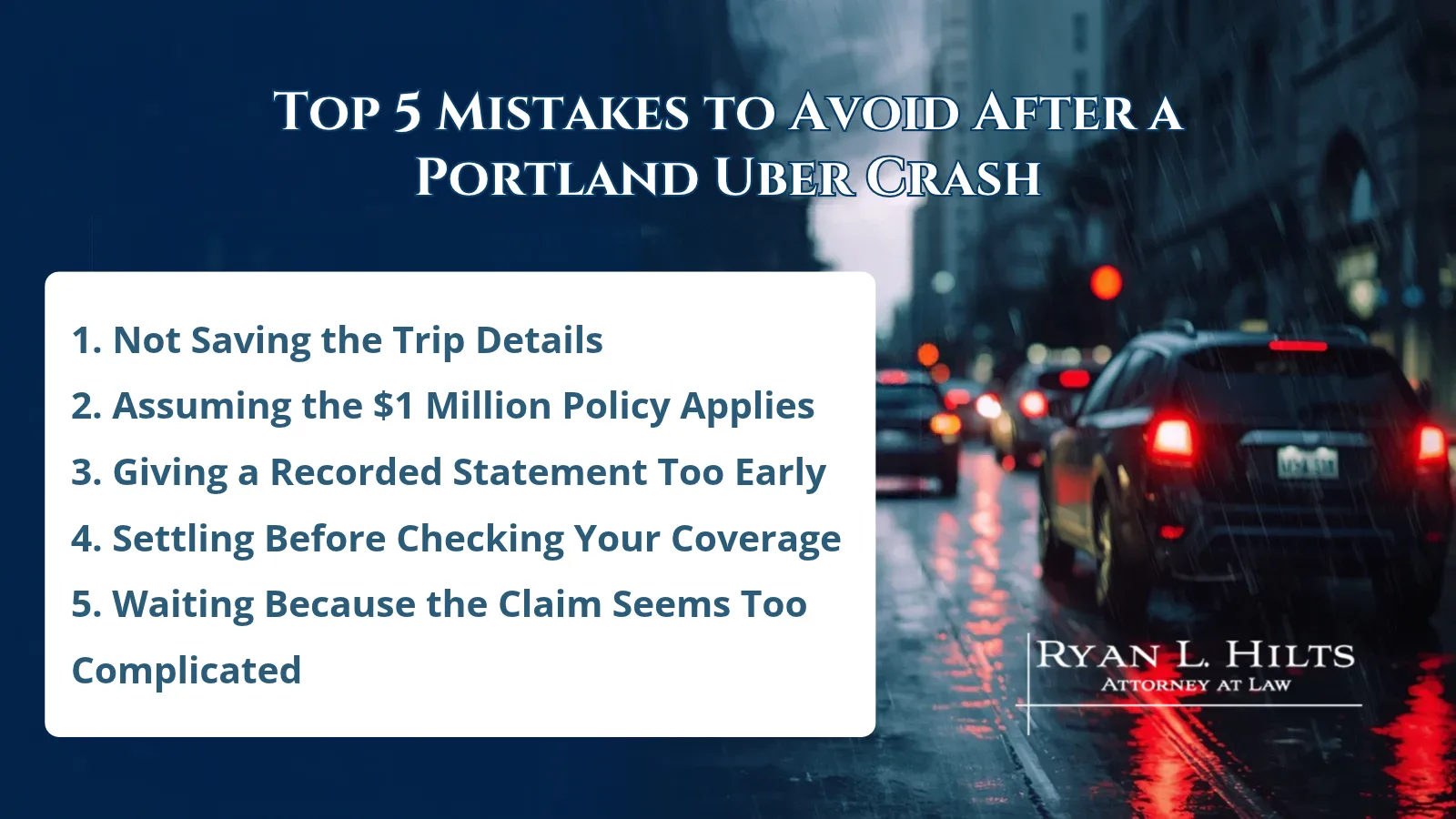
Top 5 Mistakes to Avoid After a Portland Uber Crash
Save or share this if you were hurt in a crash involving a rideshare vehicle.
1. Not Saving the Trip Details While You Still Can
The trip record in the app shows the ride was active and which coverage period applied. Screenshots you take in the days after a crash are easier to produce than records you request from the company months later.
2. Assuming the $1 Million Policy Automatically Applies
It applies from the moment a ride request is accepted until the passenger exits the vehicle. A driver who was circling an entertainment district with the app open, waiting for a match, may have been in a much lower coverage tier.
3. Giving a Recorded Statement Before You Understand the Coverage
In a rideshare claim, you may hear from several adjusters, and they don’t all represent the same interests. A statement you give before the app status and the coverage picture are clear can be hard to walk back.
4. Settling With One Insurer Before Checking Your Own Coverage
Accepting a liability settlement without your underinsured motorist insurer’s written consent may forfeit benefits you would otherwise have. An early offer that looks reasonable can be the most expensive document in the file.
5. Waiting Because the Claim Seems Complicated
The layered coverage is exactly why these claims take time. Evidence such as app records, vehicle data, and witness recollection doesn’t improve with delay, and the deadlines keep running while the insurers sort out which policy applies.
When a Portland Uber Accident Lawyer May Become Necessary
Not every rideshare crash calls for legal help. You may be able to settle a minor collision yourself when fault is clear, the injuries are limited, and the adjuster cooperates.
The situation may be different when the coverage question itself is in dispute. Consider seeking legal guidance when:
- You were injured seriously enough to need ongoing treatment
- Nobody can tell you clearly whether the driver was on an active trip
- An insurer is pointing at another insurer rather than evaluating your claim
- The available limits appear too low to cover your medical bills
- You’ve been asked to sign a release or accept an early settlement
- You were hit while walking or cycling and are unsure what coverage applies
- A public vehicle was involved and a notice deadline may be approaching
- You’re an Uber driver and your personal insurer is raising an exclusion
A Portland Uber accident lawyer can request the app and trip records, identify every policy that may respond, coordinate PIP and underinsured motorist benefits so one doesn’t undercut the other, and track the deadlines that apply to your circumstances. Ryan Hilts Law represents injured people across Oregon, and its personal injury practice area explains how these claims are handled. You may also find the firm’s guide to common mistakes people make after accidents useful.