
Bend Medical Malpractice Attorney: What to Do If a Doctor’s Mistake Caused Serious Harm

If you are looking for a Bend medical malpractice attorney, you may be dealing with a situation that feels very different from any other injury. You went to a doctor, hospital, or clinic to get better. Instead, you may be facing a new diagnosis, a second surgery, a longer recovery, or a permanent change in your health. Ryan Hilts Law helps injured Oregonians understand their options after medical negligence, and its Oregon medical malpractice practice area explains how these claims work statewide.
Medical malpractice claims are also harder to recognize than most injury claims. A car crash is obvious the moment it happens. A missed diagnosis, a medication error, or a surgical complication may not look like a mistake at first, and it may take weeks or months for anyone to connect your symptoms to the care you received.
This guide explains what Bend patients and families can do when they suspect a medical mistake. It covers how to protect your records and evidence, how Oregon’s filing deadlines work, and when it may make sense to speak with an attorney.
Also Read
TL;DR
If you believe a doctor’s mistake caused serious harm, get the medical care you need first, then request your complete medical records and write down a timeline of what happened. Keep bills and paperwork, and be careful about signing releases or other documents before you understand them.
Oregon generally allows two years from when an injury is discovered, or reasonably should have been discovered, to file a medical malpractice claim. In most cases, there is also a five-year outer limit from the date of treatment. Not every bad outcome is malpractice, and these claims usually require review by qualified medical experts. Speaking with an attorney early can help protect your options while the facts are still being sorted out.
Key Takeaways
- A poor medical outcome is not automatically malpractice. The key question is whether the provider failed to meet the accepted standard of care, and whether that failure caused your harm.
- Your health comes first. Getting follow-up or corrective care may also document what went wrong.
- You generally have a right to copies of your medical records, and requesting them early can help preserve important evidence.
- A written timeline of appointments, symptoms, and conversations can be valuable later.
- Oregon’s medical malpractice deadlines can be shorter and more complicated than many people expect.
- An apology from a provider does not necessarily mean a claim exists, and the lack of one does not mean it doesn’t.
- Oregon’s Early Discussion and Resolution process may allow patients and providers to talk about what happened outside of court.
- Be cautious about signing releases or accepting payments before you understand how they may affect your rights.
Why Bend Medical Malpractice Claims Need a Local Perspective
Bend is the medical hub for much of Central Oregon. Its hospital, surgical centers, and specialty clinics serve people from well beyond the city limits. That regional role shapes how medical care is delivered here, and it can affect how a malpractice claim develops.
Central Oregon Patients Often Travel to Bend for Care
People from Redmond, Sisters, Prineville, Madras, La Pine, and Sunriver often come to Bend for surgery, imaging, specialist appointments, and emergency treatment. A patient may see a primary care provider close to home, get a referral to a Bend specialist, and then return home for recovery and follow-up.
When care moves between communities like this, important information can fall through the gaps. A test result may not reach the right provider. A referral may be delayed. Follow-up instructions may not be clear once the patient leaves town. When these gaps cause harm, they can become central questions in a claim.
Care Is Often Spread Across Multiple Providers
A single course of treatment may involve an emergency department, a hospitalist, a surgeon, an anesthesiologist, nurses, a pharmacy, and outpatient therapists. Each may keep separate records, and some may work for different organizations.
This can make it difficult to tell who was responsible for a particular decision. It also means you may need to request records from several places to get the full picture, not just from the provider you believe made the mistake.
Visitors and Seasonal Residents
Bend draws visitors year-round for skiing, mountain biking, hiking, and river recreation, and many people split their time between Central Oregon and other states. Someone injured while visiting may receive emergency or surgical care in Bend, then continue treatment elsewhere.
If a mistake happens during that care, the patient may live hundreds of miles from the provider involved. Oregon law generally governs care provided in Oregon, and the deadlines still apply even after you return home.

What to Do First If You Suspect a Doctor’s Mistake
When you suspect a medical mistake, your first concern should be your health. The steps below can also help you understand what happened and decide what to do next.
Get the Care You Need Now
If your condition is getting worse, seek medical care right away. That may mean returning to your provider, getting a second opinion, or seeing a different specialist.
Some patients hesitate to go back to the same health system after a bad experience. You are generally free to choose where you receive further care. What matters most is that your current condition is evaluated and treated. Records from that follow-up care may also help show the extent of the harm and the treatment it required.
Request Your Complete Medical Records
Under the federal HIPAA Privacy Rule, patients generally have a right to see and get copies of their medical and billing records. HHS guidance on the right of access explains that providers must usually respond within 30 days, with a possible extension.
When you make your request, ask for the complete record, not just a visit summary. Depending on your care, that may include physician and nursing notes, operative reports, anesthesia records, medication administration records, lab and imaging results, and discharge instructions. If several providers or facilities were involved, request records from each one.
Keep copies of your written requests and note the date you sent each one.
Write Down the Timeline While You Remember It
Memories fade quickly, especially during a stressful medical event. Write down what you remember as soon as you can, while the details are still fresh.
A useful timeline may include:
- Dates of appointments, procedures, and hospital stays
- Symptoms you reported and when you reported them
- What providers told you about your diagnosis, risks, and treatment
- Instructions you received at discharge
- When new symptoms started, or existing ones got worse
- Names of providers you spoke with, if you know them
If family members were present, ask them to write down what they remember as well. Their account may include details you missed.
Keep Bills, Paperwork, and Communications
Save medical bills, insurance explanation-of-benefits statements, pharmacy receipts, and any letters or emails from providers or their insurers. Keep your patient portal messages, too. Take screenshots if you are concerned that you might lose access to your account.
If you have leftover medication, packaging, or medical devices connected to your care, keep them in a safe place. They may become important later.
Be Careful Before Signing Anything
After a medical error, a provider, hospital, or insurer may contact you to discuss what happened. Some of these conversations may be sincere efforts to explain and resolve the situation.
Before you sign a release, settlement agreement, or other document, make sure you understand what rights you may be giving up. Once you release a claim, it generally cannot be reopened, even if you later learn your injuries are more serious than they first seemed.
What Counts as Medical Malpractice in Oregon?
Medicine involves real risk, and not every complication or poor result means that someone did something wrong. A surgery can be performed correctly and still fail. A medication can cause a known side effect even when it was properly prescribed.
Medical malpractice generally involves a provider failing to meet the standard of care. In other words, they did not act as a reasonably careful provider in the same field would have under similar circumstances. To bring a claim, a patient typically needs to show that:
- The provider owed the patient a duty of care
- The provider failed to meet the accepted standard of care
- That failure caused the patient’s injury
- The patient suffered actual harm as a result
Causation is often the most contested part of a claim. A provider may argue that the patient’s underlying condition, not the treatment, caused the harm. Answering that question usually requires qualified experts to carefully review the medical records.
Common Types of Medical Malpractice Claims
Medical malpractice claims can arise from many kinds of care, including:
- Misdiagnosis or delayed diagnosis: A condition such as cancer, infection, stroke, or heart attack is missed or identified too late.
- Surgical errors: Preventable mistakes during or after surgery, including wrong-site procedures and retained surgical items.
- Medication errors: Incorrect prescriptions, wrong doses, dangerous drug interactions, or medication given to the wrong patient.
- Anesthesia mistakes: Errors in dosing, monitoring, or responding to complications.
- Birth injuries: Preventable harm to a mother or newborn during pregnancy, labor, or delivery.
- Hospital and nursing negligence: Failures in monitoring, communication, infection control, or following established procedures.
- Dental malpractice: Injuries caused by negligent dental procedures. Learn more in our guide to dental malpractice.
- Nursing home neglect: Harm to residents from inadequate care. Learn more about nursing home abuse and neglect claims.
Oregon Deadlines for Medical Malpractice Claims
Deadlines are one of the most important and most misunderstood parts of a medical malpractice claim.
Under ORS 12.110(4), a claim for injuries arising from medical, surgical, or dental treatment generally must be filed within two years from the date the injury is first discovered, or reasonably should have been discovered. This is often called the discovery rule.
The same statute also sets an outer limit. In most cases, a claim must be filed within five years from the date of the treatment, omission, or operation, even if the injury was not discovered until later. An exception applies when fraud, deceit, or misleading representation prevented the claim from being filed on time. In that situation, the law generally allows two years from when the fraud or deception is discovered, or reasonably should have been discovered.
Other rules may also affect your deadline:
- Claims involving children may follow different timing rules.
- Claims against a public body, such as a government-operated clinic or hospital, may require a formal notice of claim much sooner than the lawsuit deadline.
- When medical negligence results in a death, wrongful death rules apply. Learn more about Oregon wrongful death claims.
Because the discovery date can be disputed, many people underestimate how much time has already passed. If you suspect a medical mistake, it may be wise to speak with an attorney before you assume you still have time.
Oregon’s Early Discussion and Resolution Process
Oregon has a program that many patients don’t know exists. The Oregon Patient Safety Commission runs a process called Early Discussion and Resolution, or EDR. It helps patients and health care providers talk openly after serious harm.
What EDR May Offer
EDR can apply when an adverse health care incident results in death or serious physical injury. A patient, provider, or health care facility can start the process by filing a notice with the Patient Safety Commission. The parties may then discuss what happened and, if needed, move to mediation.
For some families, EDR may provide answers they could not get any other way. It may also lead to an apology, changes in care practices, or compensation.
What to Understand Before Participating
Under ORS 31.272, taking part in EDR does not prevent you from later filing a negligence lawsuit unless you sign a release of your claim. The statute of limitations is generally paused for 180 days after a notice is filed, or for another period the parties agree to.
Oregon law also protects certain apologies. Under Oregon law, an expression of regret or apology from a licensed physician or dentist generally does not count as an admission of liability. That protection does not limit your right to pursue a claim. It simply means an apology alone may not prove malpractice occurred.
Because a signed release can end your claim, it may help to get legal guidance before agreeing to any resolution through EDR.
How Medical Malpractice Claims Are Investigated
A medical malpractice claim usually begins long before you file anything in court. The first step is often a detailed review of your complete medical records to understand what care you received and when.
Next, qualified medical experts may review the records. They can offer opinions on the required standard of care, whether it was met, and whether a failure caused your injuries. Many cases depend on this expert review, which is one reason medical malpractice claims can take more time than other injury cases.
An investigation may also look at who was involved in your care, which organizations employed them, what policies applied, and what insurance coverage may exist. Oregon law generally requires the parties in a medical negligence lawsuit to participate in some form of dispute resolution, such as mediation or a settlement conference, within 270 days after the case is filed, unless the case resolves sooner or the parties agree to waive it.
What Compensation May Be Available After Medical Malpractice?
A medical mistake can affect far more than your health. It can change your ability to work, your finances, and your daily life. The losses you may be able to pursue depend on the facts of your case and what Oregon law allows.
Medical Expenses and Future Care
Compensation may include the cost of treatment needed to address the harm, such as corrective surgery, hospitalization, medications, rehabilitation, and therapy. When an injury is long-term, it may also include reasonable future medical care. A physician or life-care planner may help estimate those future needs.
Lost Income and Earning Capacity
If the injury kept you from working, lost wages may be part of your claim. Pay records, tax documents, and employer statements can help document these losses. If the injury permanently limits your ability to work, reduced future earning capacity may also be considered.
Pain and Other Non-Economic Losses
Medical harm often brings losses that don’t come with an invoice, such as physical pain, emotional distress, loss of independence, and the inability to enjoy activities that used to be part of your life. For many people in Central Oregon, that may include hiking, skiing, or time outdoors. These effects may also support a claim when the evidence supports them.
When Malpractice Results in Death
When a medical mistake causes a death, the family may be able to pursue a wrongful death claim. Depending on the case, that may include medical and funeral expenses, the loss of financial support, and the loss of the person’s companionship. These claims follow their own rules and deadlines.
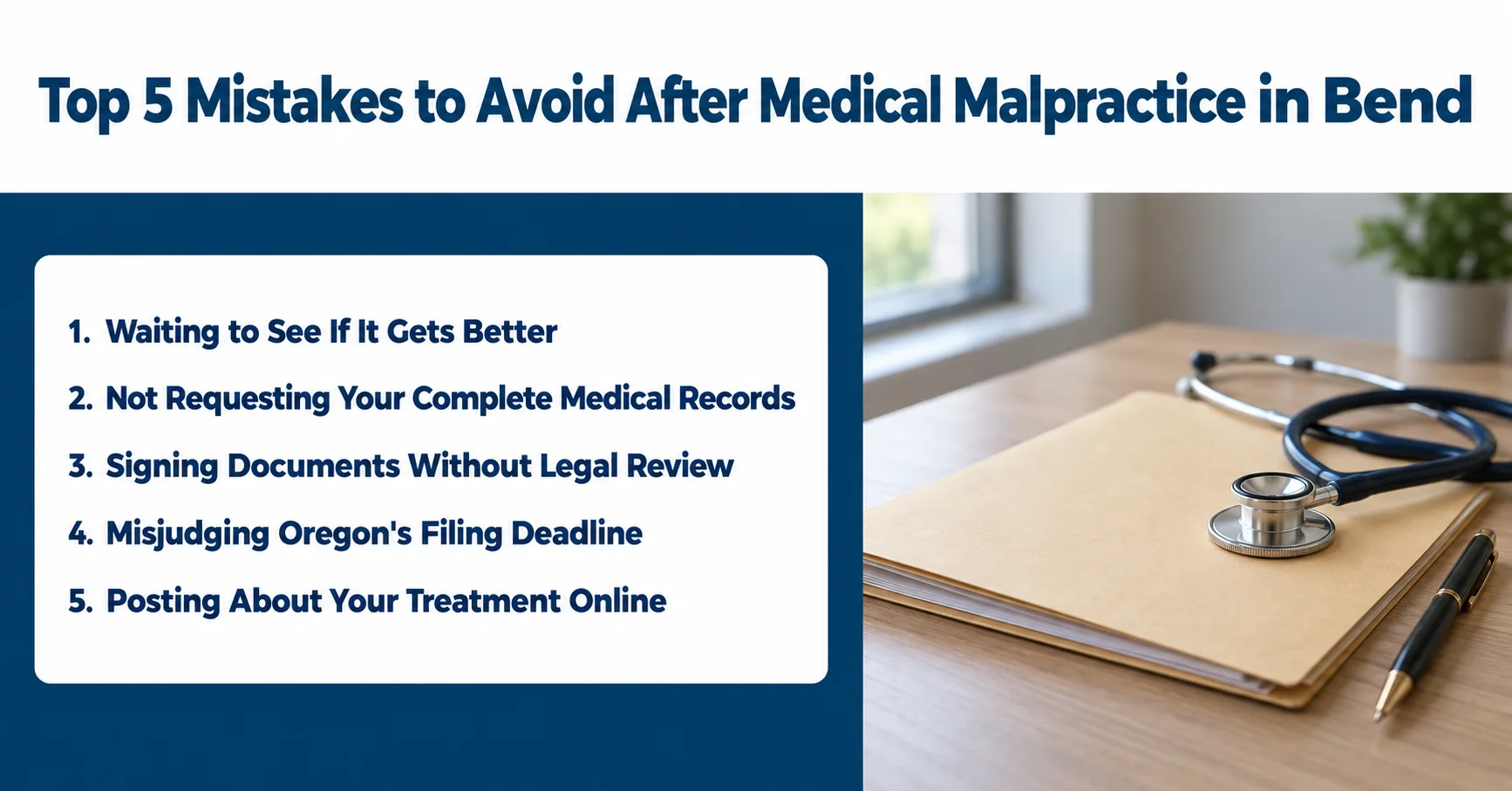
Top 5 Mistakes to Avoid After Medical Malpractice in Bend
Save or share this if you’re worried a medical mistake harmed you or a loved one.
1. Waiting to See If It Gets Better
Hoping a problem will resolve on its own is understandable, but waiting can harm both your health and your claim. Worsening symptoms deserve prompt medical attention, and delays can also use up the time Oregon law allows to file.
2. Not Requesting Your Complete Medical Records
A visit summary is not the same as your full medical record. Request complete records from every provider involved in your care, and keep a copy of each request.
3. Signing Documents Without Legal Review
A release, settlement agreement, or billing waiver may affect your legal rights. Make sure you understand what a document means before you sign it, especially if you are still being treated.
4. Misjudging Oregon’s Filing Deadline
Many people assume the deadline starts on the date of surgery or treatment, or that they have more time than they do. The discovery rule and the five-year outer limit can interact in complicated ways, so it is safer to get your deadline evaluated early.
5. Posting About Your Treatment Online
Insurance companies and defense attorneys may review what you post publicly. Comments about your care, your recovery, or the providers involved can be taken out of context. Share details with your medical providers and your attorney instead.
When a Bend Medical Malpractice Attorney May Become Necessary
Not every medical complication leads to a legal claim. Some poor outcomes are known risks of treatment, and some problems can be resolved through direct communication with the provider.
The situation may be different when the harm is serious, or the answers don’t add up. Consider seeking legal guidance when:
- You needed additional surgery or treatment to correct a problem
- A diagnosis was missed or significantly delayed
- You received the wrong medication or dose
- Your condition is permanent or long-term
- You were told little or nothing about what went wrong
- A provider or insurer is asking you to sign a release
- You are unsure whether a filing deadline is approaching
- A loved one died after care that raised concerns
A Bend medical malpractice attorney can review your records, arrange expert evaluation, identify the parties who may be responsible, and track the deadlines that apply to your situation. Ryan Hilts Law represents injured patients in Bend and throughout Central Oregon, and its Oregon medical malpractice practice area explains how these claims are handled.