If you are looking for a Salem car accident attorney after being hit by another driver, the first few days after the crash can have a lasting effect on your claim. Medical treatment, accident reporting, photographs, witness information, insurance communication, and documentation all matter. Ryan Hilts Law helps injured Oregonians understand these issues, and its car accident practice area provides additional information about handling an Oregon collision claim.
Salem also presents accident risks that are different from Portland, Bend, and other Oregon communities. I-5 carries commuters and commercial traffic along the city’s eastern side, while Commercial Street SE handles substantial local traffic through South Salem. Mission Street, Lancaster Drive, downtown streets, and major intersections add their own congestion and turning conflicts.
This guide focuses specifically on what Salem drivers should do after a collision, how local road conditions can affect a claim, what evidence should be preserved, and what happens when the insurance process becomes more complicated than expected.
Also Read
TL;DR
After a Salem car accident, get to a safe location when possible, check for injuries, exchange information, document the scene, seek appropriate medical care, and notify your insurer. Oregon also requires drivers to submit a collision report to DMV within 72 hours when specific injury, death, towing, or property-damage thresholds are met.
A Salem injury claim can involve more than the immediate crash. Medical expenses, missed work, vehicle damage, disputed fault, insurance coverage, and future treatment may all need to be addressed. Accidents on I-5 and heavily traveled Salem streets can also involve multiple vehicles or complicated evidence. Avoid settling before you understand the full impact of your injuries.
Key Takeaways
- Prioritize safety and medical needs immediately after a Salem collision.
- Photograph vehicle damage, roadway conditions, traffic controls, and the surrounding accident scene.
- Collect driver, insurance, and witness information before leaving when possible.
- Oregon DMV reporting requirements are separate from simply calling police.
- I-5 crashes may involve higher speeds, commercial vehicles, and multiple drivers.
- Commercial Street SE and other Salem surface streets create different risks involving intersections, turning vehicles, pedestrians, and frequent driveways.
- Keep medical, employment, repair, and insurance records together from the beginning.
- Be cautious about recorded statements and early settlement offers when injuries are still developing.
Why Salem Car Accident Attorney Claims Require a Local Approach
Salem is not simply a smaller version of Portland. The city’s road network, commuter patterns, government employment base, surrounding agricultural traffic, and position along I-5 create a different driving environment.
A person commuting north or south on I-5 faces very different risks from someone traveling along Commercial Street SE during afternoon traffic. Likewise, a downtown intersection collision may require different evidence than a high-speed freeway crash.
That matters because location can help explain how an accident occurred.
I-5 Accidents Through Salem
Interstate 5 runs along the eastern portion of Salem and carries local commuters, interstate travelers, freight traffic, and commercial vehicles.
Highway collisions can become serious quickly because vehicles are traveling at higher speeds. A sudden slowdown, unsafe lane change, distracted driver, or failure to maintain adequate following distance can produce a multi-vehicle collision rather than a simple two-car crash.
Evidence may also disappear quickly on a freeway. Damaged vehicles are removed, debris is cleared, traffic resumes, and witnesses continue traveling toward their destinations.
When you can safely do so, documenting the vehicles and surrounding conditions before the scene changes can be valuable.
Commercial Street SE and South Salem Traffic
Commercial Street SE presents a different set of concerns.
Rather than sustained freeway speeds, drivers encounter frequent intersections, businesses, driveways, turning vehicles, pedestrians, and changing traffic conditions. The City of Salem Transportation Services provides information about the city’s transportation network and safety initiatives. These local conditions can become relevant when evaluating collisions involving intersections, turning movements, driveways, pedestrians, and other roadway conflicts.
For an injury claim, those local conditions can matter. A driver turning across traffic, pulling from a business driveway, failing to yield at an intersection, or following another vehicle too closely may create a very different collision than one occurring on I-5.
Mission Street and Major Salem Intersections
Mission Street connects important areas of Salem while also providing access toward I-5. Drivers regularly encounter turning traffic, signals, commercial access points, and periods of significant congestion.
Intersection crashes frequently involve disputes over:
- Who had the right of way
- Traffic signal status
- Whether a driver was speeding
- Whether someone failed to yield
- Whether a driver was distracted
- Whether visibility was limited
Witness statements, photographs, nearby surveillance footage, vehicle damage patterns, and traffic-control information can become important when the drivers provide conflicting accounts.

What to Do Immediately After Being Hit by a Driver in Salem
The first priority after any collision is safety.
A legal claim matters, but it should never take priority over getting injured people out of immediate danger and obtaining emergency assistance.
Move Out of Traffic When It Is Safe
If no one is seriously injured and the vehicles can be safely moved, getting them out of active travel lanes may reduce the risk of a secondary collision.
Do not put yourself in danger trying to photograph vehicles or debris in moving traffic.
Check for Injuries and Call 911 When Needed
Some injuries are obvious immediately. Others may not become apparent until hours later.
Call 911 when emergency assistance is necessary. If you develop pain, dizziness, headaches, limited movement, numbness, or other symptoms after leaving the scene, do not ignore them simply because you initially thought you were fine.
Exchange Driver and Insurance Information
Collect the other driver’s:
- Name
- Contact information
- Driver license information
- Vehicle information
- License plate
- Insurance carrier
- Policy information
Photographing documents can reduce the chance of incorrectly copying a number while you are shaken or distracted.
Photograph More Than Vehicle Damage
Close photographs of vehicle damage are useful, but they do not tell the entire story.
When it is safe, document:
- Final vehicle positions
- The broader roadway
- Traffic signals and signs
- Lane markings
- Skid marks or debris
- Weather conditions
- Nearby businesses
- Visible injuries
- Damage to objects other than vehicles
A wider view of the scene can help establish how the collision occurred rather than simply proving that an impact happened.
Medical Care After a Salem Car Accident
Medical care should be based on your condition, not on whether you believe you have a strong insurance claim.
Serious symptoms may require emergency treatment. Salem residents have access to local emergency and medical services, including Salem Health emergency care, along with urgent care providers, primary care physicians, specialists, physical therapists, and other healthcare professionals throughout the area.
The important point from a claim perspective is consistency.
If you report neck pain after the collision but wait several weeks before seeking care, an insurance company may question whether the injury resulted from the accident. If your physician recommends follow-up treatment and you repeatedly miss appointments, the insurer may question the severity or duration of the condition.
That does not mean every treatment gap destroys a claim. People miss appointments for legitimate reasons. It does mean that accurate medical records and reasonable follow-through make it easier to document what happened to you.
Injuries May Develop After the Scene Clears
Adrenaline can affect how a person feels immediately after a collision. Pain and stiffness may become more noticeable later.
Common accident-related complaints can involve:
- Neck and back pain
- Headaches
- Shoulder injuries
- Knee injuries
- Fractures
- Concussion symptoms
- Numbness or tingling
- Reduced range of motion
Do not diagnose yourself at the scene. Pay attention to your symptoms and seek appropriate medical evaluation when needed.
Oregon DMV Reporting Requirements After a Salem Crash
Calling police and filing a report with the Oregon DMV are not the same thing. Depending on the circumstances of the collision, you may have a separate responsibility to report the crash to DMV.
According to the Oregon DMV collision reporting requirements, a driver must submit an Oregon Traffic Collision and Insurance Report within 72 hours when the collision results in:
- Injury or death
- More than $2,500 in damage to the vehicle you were driving
- More than $2,500 in damage to any vehicle when any vehicle is towed from the scene because of collision damage
- More than $2,500 in damage to property other than a vehicle
A police report does not eliminate this responsibility. If your collision meets Oregon’s reporting requirements, you still need to submit your own report to DMV.
This is an important distinction after a Salem crash. A driver may reasonably assume that speaking with a Salem police officer or another responding agency completed the reporting process. It does not necessarily satisfy the separate DMV requirement.
Keep a copy of the information you submit for your own records.
How Insurance Works After a Salem Car Accident
Insurance becomes one of the most confusing parts of a claim because several types of coverage can become relevant at the same time.
Oregon requires drivers to carry liability insurance, Personal Injury Protection, and uninsured motorist coverage at statutory minimum levels. PIP can help with qualifying expenses after a collision regardless of who caused it, while a liability claim focuses on the losses caused by the at-fault driver.
The important point is not to treat every insurance issue as one claim.
After a serious Salem collision, you may be dealing with:
- Your own PIP coverage
- Your health insurance
- Your vehicle property damage coverage
- The other driver’s liability insurer
- Uninsured or underinsured motorist coverage
- Additional policies that may apply to the collision
Each coverage serves a different purpose.
Be Careful With Recorded Statements
An adjuster for the other driver’s insurer may ask you to provide a recorded statement about how the crash happened or how you are feeling.
You should understand who is requesting the statement and why before agreeing.
A casual description such as “I’m doing okay” may simply mean that you are relieved to be alive and able to go home. Later, however, an insurer could attempt to use that statement when evaluating injuries that became more painful over the following days.
You do not need to exaggerate your condition. You also should not minimize it.
Stick to facts and avoid guessing about speed, distance, injuries, or fault when you do not know the answer.
How Fault Can Affect a Salem Car Accident Claim
Determining which driver caused a collision is not always straightforward.
Some cases involve obvious negligence, such as a driver running a red light and striking another vehicle. Others involve competing allegations.
One driver may claim the other changed lanes without signaling. Both drivers may disagree about who had a green light. A rear-end collision may involve allegations that another vehicle stopped unexpectedly or that several vehicles contributed to a chain reaction.
Oregon uses a comparative negligence system. Under Oregon’s comparative negligence law, an injured person is not automatically barred from recovering damages because they share some responsibility for the collision. Their recovery can be reduced according to their percentage of fault, and recovery is barred when their fault is greater than the combined fault of the parties against whom recovery is sought.
That makes evidence especially important when responsibility is disputed.
Evidence That Can Help Establish Fault
Useful evidence may include:
- Police reports
- Witness statements
- Dashcam recordings
- Vehicle damage
- Accident scene photographs
- Traffic-control information
- Nearby surveillance footage
- Electronic vehicle data
- Cellphone evidence when distracted driving is suspected
Not every case requires every type of evidence. The goal is to identify what can reliably show how the collision happened before that evidence disappears.
What Compensation May Be Available After a Salem Car Accident?
A serious injury claim involves more than submitting medical bills to an insurance company.
The goal is to identify the losses caused by the collision and determine which damages Oregon law allows you to pursue.
When injuries create substantial medical expenses, lost income, or long-term limitations, understanding how an Oregon personal injury claim works can help you see how those losses may fit into the broader recovery process.
Medical Expenses
Medical damages can include treatment you have already received and reasonable future care related to your injuries.
Depending on the case, that may include:
- Emergency treatment
- Hospital care
- Surgery
- Diagnostic imaging
- Specialist appointments
- Physical therapy
- Chiropractic treatment
- Prescription medications
- Rehabilitation
- Future medical procedures
Someone treated initially at Salem Health, for example, may later need follow-up care from specialists, therapists, or other providers. The cost of the claim should not be evaluated solely from the first emergency room bill.
Lost Income and Reduced Earning Ability
A collision may prevent you from working for several days, several months, or longer.
Lost-income documentation may include:
- Pay records
- Employer statements
- Work restriction notes
- Tax documents
- Business records for self-employed individuals
A severe injury can also affect future earning capacity if you cannot return to the same job or perform the same duties.
Pain and Other Non-Economic Losses
Not every consequence of a collision comes with an invoice.
Serious injuries can interfere with sleep, mobility, recreation, family responsibilities, and daily independence. Those effects may also become part of an injury claim when supported by the circumstances and evidence.
Property Damage Is a Separate Practical Problem
Your vehicle may need repairs or may be declared a total loss while your injury claim remains open.
Keep repair estimates, towing invoices, rental vehicle records, photographs, and communications regarding the vehicle. Do not assume that resolving the property damage portion of the claim necessarily resolves the bodily injury portion.
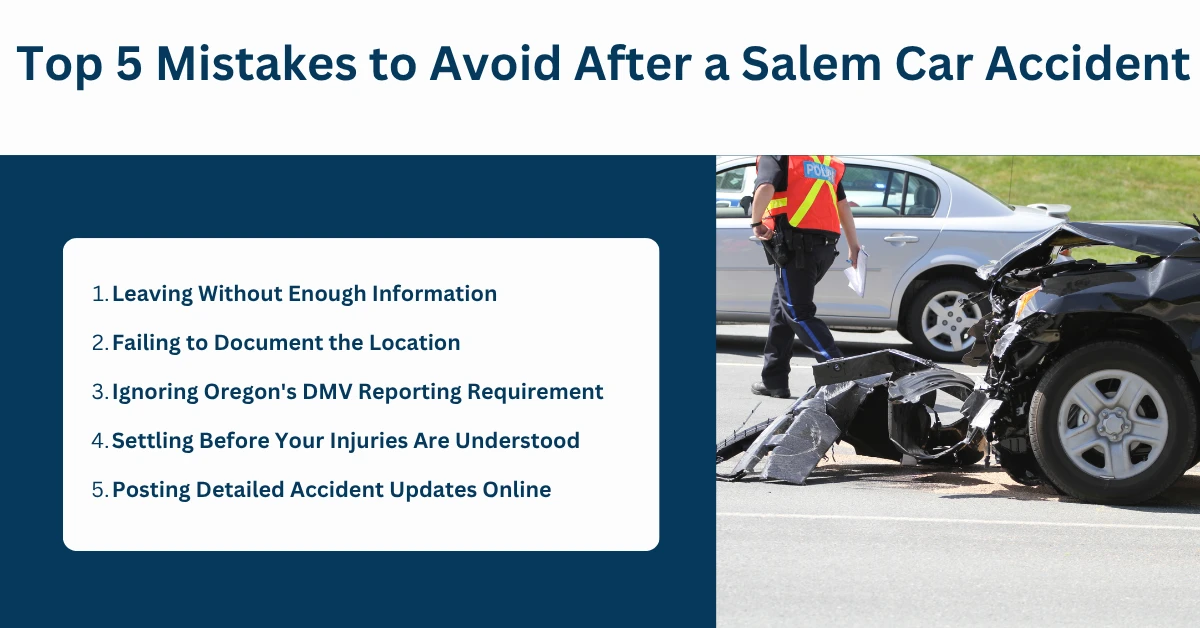
Top 5 Mistakes to Avoid After a Salem Car Accident
This is the part worth saving or sharing with someone who has just been hit by another driver.
1. Leaving Without Enough Information
Get the other driver’s identifying and insurance information whenever circumstances safely allow it. Photographing the information can be faster and more accurate than writing it down at a stressful scene.
2. Failing to Document the Location
Vehicle damage alone may not explain who caused the collision. Photograph the intersection, lanes, traffic controls, driveway entrances, road conditions, and final vehicle positions when it is safe.
3. Ignoring Oregon’s DMV Reporting Requirement
Do not assume the police handled everything. Determine whether your collision meets the separate DMV reporting requirements and, if it does, submit the required report within the applicable timeframe.
4. Settling Before Your Injuries Are Understood
A fast settlement may sound useful when bills are arriving, but resolving an injury claim before your condition is reasonably understood can create problems if you later need additional treatment.
5. Posting Detailed Accident Updates Online
Insurance companies may review publicly available information. Photos, activity updates, comments about your recovery, or descriptions of the crash can be taken out of context.
You do not need to document your recovery for social media. Document it for your medical providers and your claim.
Why I-5 Crashes Can Become More Complicated
A collision on I-5 may involve factors that are less common in a neighborhood crash.
Higher speeds can produce more severe injuries and extensive vehicle damage. Multiple vehicles may become involved in a chain reaction. Commercial trucks may introduce corporate defendants, separate insurance policies, driver records, or vehicle maintenance questions.
Witnesses can also be difficult to locate because they may live outside Salem or even outside Oregon.
If you are physically able at the scene, collecting witness contact information can therefore be particularly important after a freeway collision.
Evidence preservation may also need to happen quickly. Commercial vehicle records, electronic information, photographs, and other materials can become relevant depending on what caused the crash.
Drivers dealing with a serious freeway collision can also review what to expect after an I-5 auto accident in Oregon, including important considerations following a high-speed crash.
What Makes Commercial Street SE Claims Different?
Commercial Street SE deserves separate attention because the accident pattern is fundamentally different from an interstate collision.
Drivers move between traffic, businesses, parking areas, side streets, and major intersections. Vehicles may enter traffic from driveways, turn across lanes, or stop for pedestrians. During congested periods, a driver following too closely may have little time to react to a vehicle stopping ahead.
When investigating a collision on Commercial Street SE, the exact location matters.
Questions may include:
- Was one driver leaving a business?
- Was a vehicle making a left turn?
- Was the collision at a signalized intersection?
- Was a pedestrian or cyclist involved?
- Were parked vehicles affecting visibility?
- Did a nearby business have surveillance cameras?
- Were lane markings or traffic controls relevant?
Those details help make a Salem claim specific to what actually happened rather than treating every car accident as interchangeable.
When a Salem Car Accident Attorney May Become Necessary
Not every fender bender requires an attorney.
A minor property-damage claim with no injuries may be resolved directly through insurance. The situation changes when the consequences become more serious.
Consider seeking legal guidance when:
- Your injuries require significant medical treatment
- You are missing substantial time from work
- The insurer disputes who caused the collision
- Multiple vehicles were involved
- A commercial vehicle caused the crash
- The other driver has no insurance or insufficient coverage
- The insurer disputes whether your treatment is related to the accident
- You are being pressured to settle before treatment is complete
- The collision resulted in permanent impairment or a death
A Salem car accident attorney can evaluate the insurance coverage, evidence, medical damages, lost income, and liability issues together instead of treating each problem separately.
Ryan Hilts Law’s Oregon car accident representation provides additional information for people trying to understand what happens when an ordinary insurance claim develops into a more significant injury case.