
Portland Car Accident Attorney: What Portland Drivers Need to Know After a Serious Crash
If you are searching for a Portland car accident attorney, there is a good chance you are dealing with injuries, vehicle damage, insurance company calls, and uncertainty about what comes next. Whether your collision happened on I-205, I-84, I-5, Highway 26, or a busy downtown Portland street, the steps you take after an accident can significantly affect your recovery and your legal claim.
Understanding your rights is one of the most important things you can do after a collision. Portland drivers injured by negligent motorists often turn to experienced legal counsel to help them pursue compensation and protect their interests. For additional information about Oregon auto accident claims, visit Ryan Hilts Law’s car accident practice area.
Portland presents unique driving challenges compared to many other Oregon cities. Dense commuter traffic, heavy freight movement, extensive bicycle traffic, frequent rain, and congested interstate corridors all contribute to accident risks. These local factors can affect how collisions occur, how fault is determined, and how injury claims are evaluated.
This guide explains what Portland residents should know after a crash, common accident causes throughout the city, and how Oregon law impacts injury claims.
Also Read
TL;DR
- Portland experiences thousands of traffic accidents each year.
- Crashes frequently occur on I-205, I-84, I-5, and major city streets.
- Oregon law allows injured victims to pursue compensation when another driver is responsible.
- Insurance companies often attempt to reduce claim values.
- Early medical treatment and evidence preservation can strengthen a claim.
- Legal representation can help accident victims navigate complex insurance and liability issues.
Key Takeaways
- Portland’s transportation network creates unique accident risks.
- Car accident claims often involve more than vehicle repairs.
- Medical expenses, lost income, and pain and suffering may be recoverable.
- Oregon follows a modified comparative negligence system.
- Insurance companies are not always focused on providing maximum compensation.
- Immediate action after a crash can protect important evidence.
Why Portland Car Accident Attorney Services Are in High Demand
Portland is Oregon’s largest city and one of the busiest transportation hubs in the Pacific Northwest. Every day, commuters travel between Portland, Lake Oswego, Beaverton, Tigard, Gresham, Vancouver, and surrounding communities.
This volume of traffic creates significant opportunities for accidents.
Unlike smaller Oregon cities, Portland drivers regularly encounter:
- Heavy interstate congestion
- Frequent lane changes
- Construction zones
- Bicycle traffic
- Pedestrian traffic
- Commercial trucking routes
- Public transportation interactions
Even attentive drivers cannot always avoid collisions when another motorist acts negligently.
Common forms of negligent driving include:
- Distracted driving
- Texting while driving
- Speeding
- Following too closely
- Driving under the influence
- Failure to yield
- Aggressive driving
- Unsafe lane changes
- Driver fatigue
When negligence causes injuries, Oregon law may allow victims to pursue compensation for their losses.
Portland’s Unique Traffic Challenges
Many accident claims involve circumstances that are specific to Portland’s transportation environment.
Interstate 205 Congestion
I-205 serves as a major north-south route through the metropolitan area. Traffic congestion is common throughout the day, particularly during commuting hours.
Frequent causes of accidents on I-205 include:
- Sudden traffic slowdowns
- Rear-end collisions
- Distracted driving
- Unsafe merging
- Multi-vehicle chain-reaction crashes
Because numerous vehicles may be involved, determining liability can become complicated.
Interstate 84 Traffic Risks
I-84 is one of Portland’s most heavily traveled east-west corridors.
Drivers frequently encounter:
- Commercial truck traffic
- High-speed travel
- Congestion near interchanges
- Weather-related hazards
Truck accidents on I-84 often result in more severe injuries due to the size and weight of commercial vehicles.
Interstate 5 Through Portland
I-5 remains one of the region’s busiest highways.
Accident risks increase near:
- Major interchanges
- Bridge crossings
- Construction areas
- Congested downtown sections
High traffic density often leaves drivers with little time to react when dangerous situations develop.
Downtown Portland Traffic
Downtown Portland presents challenges that differ significantly from interstate driving.
Drivers must navigate:
- One-way streets
- Pedestrian crossings
- Bicycle lanes
- Public transit vehicles
- Delivery traffic
- Limited visibility at intersections
Determining fault in downtown collisions often requires a detailed investigation.
Common Injuries Seen in Portland Car Accident Cases
The severity of injuries can vary widely depending on vehicle speeds, impact angles, and occupant positions.
Some injuries appear immediately while others develop over several days.
Soft Tissue Injuries
Soft tissue injuries affect muscles, ligaments, and tendons.
Common examples include:
- Whiplash
- Neck strain
- Back strain
- Shoulder injuries
Although sometimes dismissed as minor, soft tissue injuries can lead to long-term pain and limitations.
Traumatic Brain Injuries
Concussions and traumatic brain injuries may occur even in accidents that do not involve direct head impact.
Symptoms can include:
- Headaches
- Memory problems
- Dizziness
- Concentration difficulties
- Mood changes
Brain injuries often require extensive medical evaluation and ongoing treatment.
Spinal Injuries
Damage to the spine may result in:
- Herniated discs
- Nerve damage
- Chronic pain
- Reduced mobility
Serious spinal injuries can permanently affect a person’s ability to work and perform daily activities.
Fractures and Orthopedic Injuries
Broken bones frequently occur in high-impact collisions.
Common fractures include:
- Arms
- Wrists
- Legs
- Ankles
- Ribs
- Hips
Recovery may involve surgery, rehabilitation, and extended periods away from work.
What To Do Immediately After Being Hit by a Driver in Portland
The moments following a collision can be stressful and confusing.
Taking the right steps may help protect both your health and your legal rights.
Seek Medical Attention
Always prioritize your health.
Even if symptoms appear minor, prompt evaluation is important because some injuries may not be immediately obvious.
Medical records also create documentation that can become important evidence later.
Contact Law Enforcement
A police report can provide valuable information regarding:
- Driver identities
- Witness information
- Road conditions
- Preliminary observations regarding fault
Gather Evidence
If you are physically able, consider collecting:
- Vehicle photographs
- Roadway photographs
- Traffic signs
- Weather conditions
- Witness contact information
The more documentation available, the easier it may be to reconstruct what happened.
Notify Your Insurance Company
Most policies require timely notification of accidents.
However, providing detailed recorded statements before understanding the full extent of your injuries may not always be advisable.
Preserve All Records
Keep copies of:
- Medical bills
- Treatment records
- Repair estimates
- Insurance correspondence
- Lost wage documentation
These records may become important when calculating damages.
How Oregon’s Comparative Negligence Law Affects Your Case
One issue that frequently arises after a collision is fault.
Insurance companies often attempt to reduce payouts by arguing that the injured person contributed to the accident.
Oregon follows a modified comparative negligence system.
Under Oregon law, an injured party may recover compensation if they are found to be less than 51 percent responsible for the accident. Information regarding Oregon’s negligence laws can be found through the Oregon Legislature.
Example of Comparative Negligence
Suppose:
- Total damages equal $100,000
- The injured driver is assigned 20% fault
In that scenario, compensation would be reduced by 20%.
The recoverable amount would be $80,000.
Because fault allocation can significantly affect compensation, insurance companies often scrutinize accident details carefully.
Why Evidence Matters
Strong evidence can help counter attempts to unfairly shift blame.
Examples include:
- Dashcam footage
- Witness testimony
- Vehicle damage patterns
- Traffic camera recordings
- Expert accident reconstruction
The earlier evidence is preserved, the more useful it may become.
Compensation Available After a Portland Car Accident
Many people underestimate the financial consequences of a serious crash.
Compensation often extends far beyond vehicle repair costs.
Medical Expenses
Medical damages may include:
- Emergency room treatment
- Ambulance transportation
- Hospital stays
- Surgery
- Physical therapy
- Rehabilitation services
- Prescription medications
- Follow-up appointments
- Future treatment costs
For serious injuries, future medical expenses can represent a substantial portion of a claim.
Lost Income
When injuries prevent someone from working, financial pressure can build quickly.
Compensation may include:
- Lost wages
- Missed overtime
- Lost bonuses
- Lost commissions
- Reduced future earning capacity
Self-employed individuals may also recover income losses when supported by appropriate documentation.
Pain and Suffering
Not all accident-related losses are financial.
Pain and suffering damages may compensate for:
- Physical discomfort
- Emotional distress
- Anxiety
- Depression
- Loss of enjoyment of life
- Permanent limitations
These damages are often significant in cases involving serious injuries.
Property Damage
Property-related losses can include:
- Vehicle repairs
- Vehicle replacement
- Rental vehicle costs
- Damaged electronics
- Personal belongings inside the vehicle
Wrongful Death Damages
When an accident results in a fatality, surviving family members may have legal rights to pursue compensation.
Potential damages may include:
- Funeral expenses
- Medical expenses incurred before death
- Lost financial support
- Loss of companionship
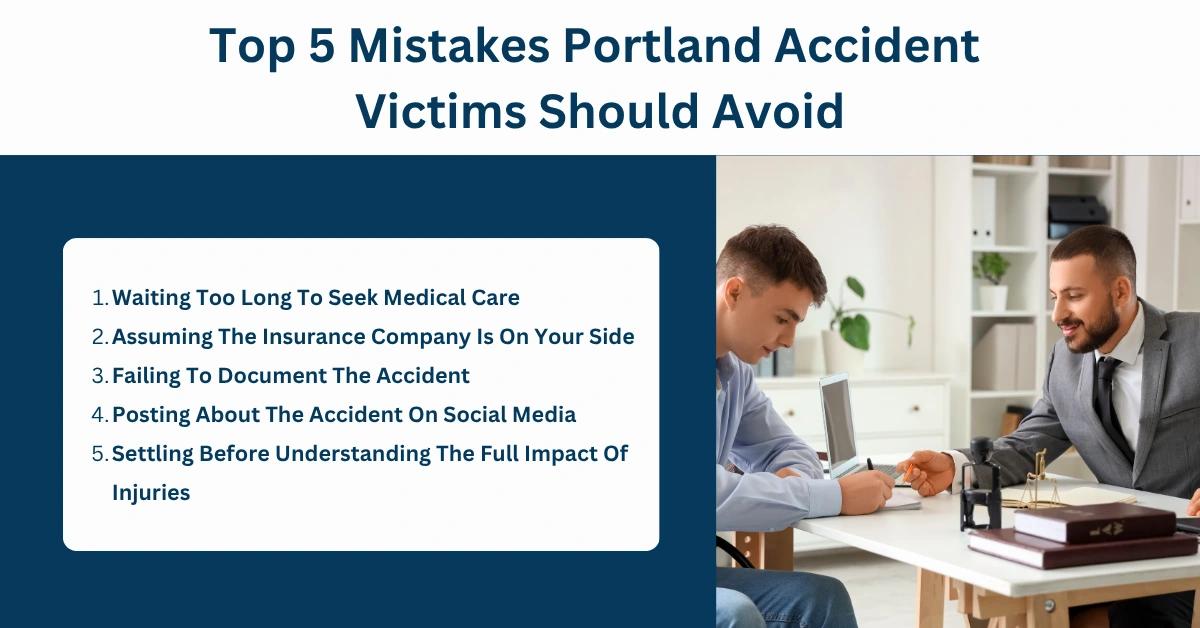
Top 5 Mistakes Portland Accident Victims Should Avoid
1. Waiting Too Long To Seek Medical Care
Delays can harm both your health and your claim.
Insurance companies often point to treatment gaps when challenging injury allegations.
2. Assuming The Insurance Company Is On Your Side
Insurance representatives work for the insurance company, not for injured claimants.
Their objective is often to minimize payouts whenever possible.
3. Failing To Document The Accident
Photographs, witness information, and medical records can become critical evidence.
The absence of documentation can make proving certain aspects of a claim more difficult.
4. Posting About The Accident On Social Media
Social media content can be reviewed and used during claim investigations.
Even innocent posts may be taken out of context.
5. Settling Before Understanding The Full Impact Of Injuries
Some injuries require weeks or months before their long-term effects become clear.
Resolving a claim too quickly can leave accident victims responsible for future expenses.
When Should You Contact an Attorney After a Portland Car Accident?
Not every accident requires legal representation. However, certain situations significantly increase the value of obtaining legal guidance.
You may benefit from speaking with an attorney if:
- You suffered injuries requiring medical treatment
- The insurance company disputes fault
- Multiple vehicles were involved
- A commercial truck contributed to the crash
- The at-fault driver was uninsured or underinsured
- You missed work because of your injuries
- A family member suffered catastrophic injuries
- A wrongful death occurred
The sooner a case is evaluated, the easier it may be to preserve important evidence and identify potential issues before they become obstacles.
The Importance of Acting Quickly After a Crash
One of the biggest mistakes accident victims make is waiting too long to take action.
Evidence can disappear faster than many people realize.
Potential evidence includes:
- Surveillance footage
- Traffic camera recordings
- Witness recollections
- Vehicle damage documentation
- Electronic vehicle data
Additionally, medical records created shortly after a collision often provide some of the strongest evidence connecting injuries to the crash.
Prompt action can help strengthen a claim and reduce opportunities for insurance companies to challenge important facts.
After a serious collision, many victims are unsure whether they need legal representation. While every case is different, speaking with a Portland car accident attorney can help you understand your rights, evaluate potential compensation, and avoid common mistakes when dealing with insurance companies. Learn more about your legal options through Ryan Hilts Law’s car accident practice area.
Frequently Asked Questions
How long do I have to file a car accident claim in Oregon?
Oregon law establishes deadlines for filing personal injury claims. Missing these deadlines can prevent recovery entirely. Because every case is different, it is important to evaluate potential claims as soon as possible after an accident.
What should I do if I was hit by a driver in Portland who left the scene?
Hit-and-run accidents can be frustrating and overwhelming. Report the crash to law enforcement immediately, seek medical treatment, document the scene if possible, and notify your insurance company. Uninsured motorist coverage may provide protection in certain situations.
Can I recover compensation if I was partially at fault?
Yes. Oregon follows a modified comparative negligence system. As long as your percentage of fault remains below 51 percent, you may still recover compensation. Your recovery may be reduced according to your percentage of fault.
How much is my Portland car accident case worth?
There is no universal value for a car accident claim. Factors that influence value include:
- Injury severity
- Medical expenses
- Future treatment needs
- Lost income
- Pain and suffering
- Liability issues
- Available insurance coverage
A thorough evaluation is necessary before determining a reasonable claim value.
What if the other driver does not have insurance?
Many Oregon drivers carry uninsured motorist and underinsured motorist coverage. These coverages may provide compensation when the at-fault driver lacks sufficient insurance.
Conclusion
A serious collision can create physical, emotional, and financial challenges that last far longer than most people expect. Portland drivers face unique risks due to heavy commuter traffic, congested interstate corridors, commercial trucking activity, bicycle traffic, and changing weather conditions.
Whether your accident occurred on I-205, I-84, I-5, or a busy Portland city street, understanding your legal rights is an important step toward protecting your future. Medical expenses, lost wages, pain and suffering, and other damages can place significant stress on individuals and families after a crash.
If you are searching for a Portland car accident attorney, obtaining experienced legal guidance early in the process can help preserve evidence, navigate insurance company tactics, and position your claim for the strongest possible outcome. Taking action promptly can make a meaningful difference in both your recovery and your ability to pursue fair compensation under Oregon law.
About the Author
Ryan Hilts is an experienced personal injury attorney serving clients throughout Oregon and Washington. With nearly two decades of experience handling car accidents, truck accidents, wrongful death claims, and other serious injury cases, Ryan is committed to providing personalized legal representation for every client. Through Ryan Hilts Law, he helps injury victims navigate complex legal claims while pursuing the compensation they deserve. To learn more about Ryan’s background, experience, and approach to client advocacy, visit the About Ryan page.

