
Underinsured Motorist Lawyer: When the Other Driver’s Coverage Isn’t Enough

Underinsured motorist lawyer is the phrase many people search after they hear the words: “The other driver only has minimum limits.” It’s a punch to the gut. You’re dealing with injuries, missed work, and medical bills, and now you’re being told the coverage may not come close to covering the harm.
In Oregon, underinsured motorist (UIM) coverage is designed for exactly this scenario. If you’re trying to understand your options, an Oregon car accident practice area overview from Ryan Hilts can help frame how these claims typically unfold and what usually happens next.
TL;DR
When the other driver’s liability limits are too low, your own underinsured motorist (UIM) coverage may step in. Oregon’s UIM framework is tied to uninsured motorist coverage rules under ORS 742.502. The most important moves are: get medical care, document damages, confirm the at-fault driver’s limits, notify your insurer, avoid quick settlements, and get legal guidance if the insurer disputes fault or value. ORS 12.110 generally provides a two-year deadline for injury claims, so timing matters.
Also Read
- Portland Hit and Run Lawyer: What to Do After the Driver Flees the Scene
- Top Car Accident Attorneys in Bend, Oregon
- 5 Signs It’s Time to Call a Rideshare Injury Lawyer vs. Handling It Yourself
- What Happens If the Other Driver Is Uninsured in Oregon? Here’s What You Must Do Immediately
- Common Mistakes People Make After Accidents And How to Avoid Them
Key Takeaways
- “Underinsured” means “not enough,” not “none.” UIM applies when the other driver has insurance, but the limits won’t cover your damages.
- Your insurer becomes the opposing party in a UIM claim. Even though it’s your policy, the carrier still evaluates (and often challenges) fault and damages.
- Confirm limits early and preserve evidence fast. The value of a UIM claim depends on proof: medical records, wage loss documentation, and future care needs.
- Watch for settlement traps. Settling with the at-fault driver too early (or without proper steps) can jeopardize your ability to pursue UIM.
- Deadlines are real. ORS 12.110 generally gives two years to file suit for injury claims in Oregon.
1) What “underinsured” means in Oregon
A driver is “underinsured” when their liability coverage is real, but insufficient. That can happen fast. A single ambulance ride, ER visit, imaging, follow-ups, and missed work can exceed minimum limits.
Oregon’s statutory framework recognizes underinsurance coverage in ORS 742.502 and ties it to the uninsured motorist structure. In plain language: UIM is meant to help close the gap between what you’re legally entitled to recover and what the at-fault driver can actually pay through their policy.
If the other driver’s insurance is “real but low,” a UIM path may exist, but how you handle the claim steps matters.
 2) The most common situations where UIM comes into play
Here are the scenarios where an underinsured motorist lawyer is often helpful:
- High medical bills from a “moderate” crash (concussions, disc injuries, fractures).
- Multiple injured people in one collision. One policy limit gets split across multiple claims.
- Commercial vehicle complications (work trucks, delivery drivers, rideshare overlaps).
- Disputed fault. Your insurer may argue you were partially at fault to reduce what it pays.
If the crash is serious or messy, UIM claims tend to turn into evidence-and-negotiation battles.
3) What to do immediately when you learn the other driver’s limits aren’t enough
Once the at-fault driver’s adjuster signals “policy limits,” your next moves should be deliberate.
Step-by-step checklist
- Get all treatment documented. Follow up, comply with referrals, and keep a symptom timeline.
- Request written confirmation of the at-fault driver’s limits. This becomes a key foundation document.
- Collect wage-loss proof. Pay stubs, employer letters, missed hours, and disability documentation.
- Track out-of-pocket costs. Travel to treatment, prescriptions, medical equipment, home assistance.
- Notify your own insurer about a potential UIM claim. Don’t wait until you “wrap up” the liability case.
UIM claims aren’t just about the crash, they’re about proving the full financial and human impact.
4) How underinsured motorist claims actually work
Many people assume, “It’s my insurance, so they’ll take care of me.” In practice, a UIM claim often feels like a second case layered on top of the first.
Your carrier may:
- dispute whether the other driver was fully at fault,
- argue your treatment was excessive,
- question whether certain conditions were preexisting,
- downplay future care needs or time off work.
Oregon’s statute (ORS 742.502) sets the baseline concept of underinsurance coverage and its relationship to UM rules, but the real-world outcome turns on documentation and negotiation.
UIM claims can be adversarial, even though you’re dealing with your own policy.
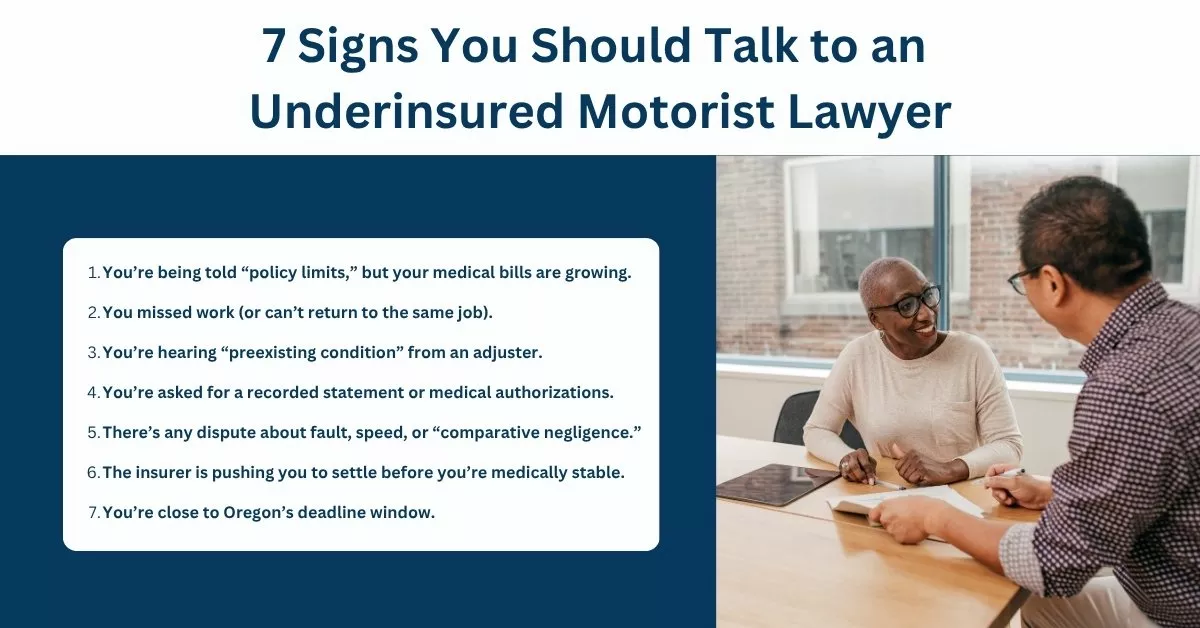 5) 7 signs you should talk to an underinsured motorist lawyer
If any of these sound familiar, it’s usually time to get help.
- You’re being told “policy limits,” but your medical bills are still growing.
- You missed work (or can’t return to the same job).
- You’re hearing “preexisting condition” from an adjuster.
- You’re being asked for a recorded statement or broad medical authorizations.
- There’s any dispute about fault, speed, or “comparative negligence.”
- The insurer is pushing you to settle before you’re medically stable.
- You’re close to Oregon’s deadline window. ORS 12.110 generally provides two years for injury claims.
When the stakes are high, getting legal guidance early can prevent irreversible mistakes.
6) Don’t accidentally harm your UIM claim
Two common issues come up again and again:
Settling too early
A fast settlement can feel like relief, but if you settle before understanding future care needs, you may be stuck paying the difference.
Not coordinating the liability settlement with the UIM process
UIM claims often require careful sequencing. If you’re unsure what approvals or notices are required before settling the liability portion, getting legal advice is the safest move.
The order of operations matters in UIM cases.
 Conclusion
When the other driver’s insurance isn’t enough, the situation can feel unfair: because it is. Oregon’s underinsured motorist rules exist to help close that gap, but UIM claims can become complex quickly, especially when the insurer disputes fault, medical necessity, or future damages. ORS 742.502 is the core statute describing underinsurance coverage in Oregon.
If you’re weighing next steps, the about page explains Ryan Hilt’s approach to injury cases and what clients can expect. And if you want to talk through your situation, reach out to discuss a potential underinsured motorist claim.
FAQ
What is underinsured motorist coverage in Oregon?
Underinsured motorist coverage helps pay damages when the at-fault driver has insurance but not enough to cover what you’re legally entitled to recover. Oregon’s statutory framework for underinsurance coverage is addressed in ORS 742.502.
Is underinsured motorist coverage the same as uninsured motorist coverage?
No. UM applies when the at-fault driver has no insurance; UIM applies when they have insurance but low limits. Oregon resources commonly explain the distinction in practical terms.
How long do I have to pursue a claim in Oregon?
For many personal injury claims in Oregon, ORS 12.110 states the action must be commenced within two years.
Can my own insurance company fight my UIM claim?
Yes. In a UIM claim, your insurer may still dispute fault or damages. That’s one reason many people consult an underinsured motorist lawyer when injuries are serious.
What should I do first if I suspect the other driver’s coverage won’t be enough?
Start by confirming policy limits in writing, documenting your medical care and wage loss, and notifying your insurer early that a UIM claim may be needed.
About the Author
Ryan Hilts represents injured people across Oregon in serious auto collision matters, including cases where the at-fault driver’s policy limits aren’t enough. Ryan is a member of the Oregon State Bar, the Washington State Bar, and the Oregon Trial Lawyers Association. He has been named a “Super Lawyer” by Super Lawyers Magazine for the past four years. Before he turned 40 he was named as a “Rising Star” for six years in a row. In his early years as attorney, Ryan was also listed as one of Oregon’s Outstanding Young Lawyers by Portland Monthly Magazine.

